

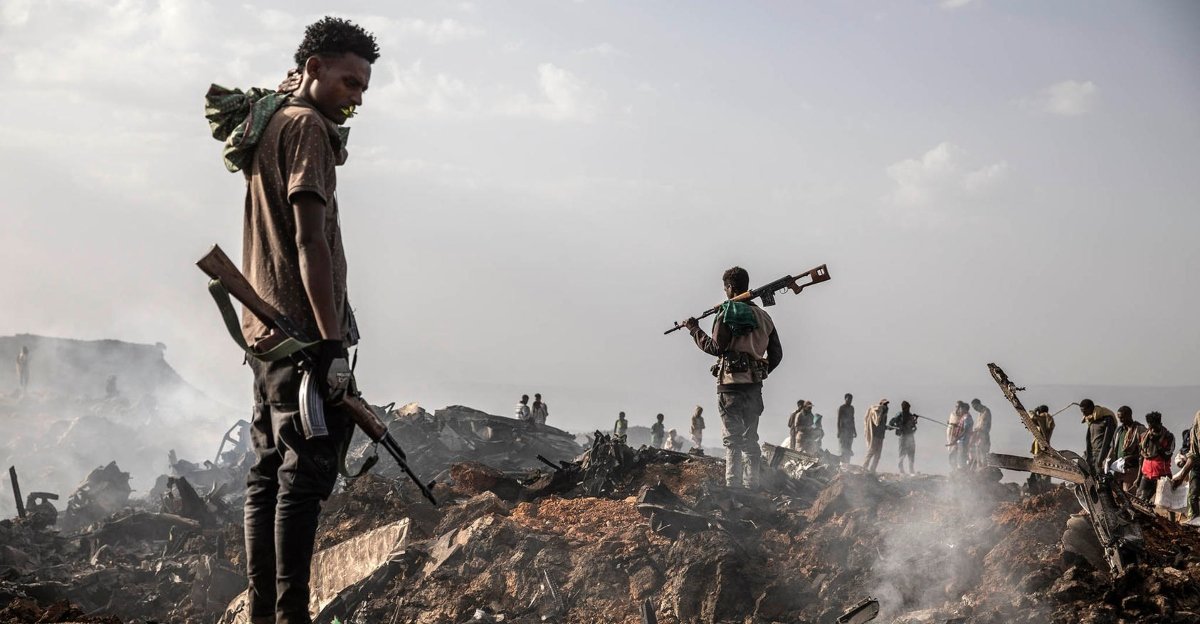
Ethiopia is close to falling into full collapse as the government in Addis Ababa urges civilians to take up arms against advancing Tigrayan forces. This crisis is escalating even though the United States and other nations are calling for an immediate ceasefire. The U.S. has warned its citizens that there will be no emergency evacuation like in Kabul and advised them to leave the country immediately. The situation could worsen very soon.
The conflict began over a year ago when Ethiopia’s government and its allies launched military operations against the Tigray People’s Liberation Front (TPLF), the ruling party of the northern Tigray region. Since then, reports have emerged of ethnic cleansing, starvation being used as a weapon, and serious human rights abuses by both sides. Now, TPLF forces are within about 200 miles of the capital, and both sides are preparing for major fighting.
A full-scale civil war would deepen Ethiopia’s already severe humanitarian crisis and threaten stability across the region. Ethiopia is Africa’s second-most populous country, with about 115 million people, and Addis Ababa hosts the African Union headquarters, making the situation even more complicated.
Attempts at peace have failed because neither the Ethiopian government nor the TPLF is willing to compromise. Their visions for the country are completely opposed, and both see violence as the path to achieving their goals.
Ethiopia’s complex political and cultural landscape also makes it hard for outside diplomats to grasp the full picture. Any lasting peace deal must take into account the country’s more than 80 ethnic groups and 10 regional states. Deep divisions, rooted in Ethiopia’s expansion into neighboring regions in the 19th century, still shape the nation today. Those regions had very different cultures, languages, and identities, and the unequal structure that formed remains a major source of tension.